



How to calculate VAT in Lithuania (0)

How to calculate VAT
Calculating VAT may seem simple at first. In practice, questions often arise about how to add VAT to a price, extract it from a total price and calculate the amount payable to the tax authority.
A common mistake is to assume that removing 21% VAT from a gross price means reducing the total by 21%. This does not produce the correct result because VAT is calculated from the net price, not from the final price including VAT.
This guide explains how to calculate VAT, which formulas to use and how output VAT, input VAT and the final amount payable differ.
What is VAT?
VAT is a value added tax applied to most goods and services sold in Lithuania. A business registered for VAT adds the tax to the price of taxable goods or services, collects it from the customer and reports it to the Lithuanian State Tax Inspectorate.
Three amounts must be distinguished when calculating VAT:
- The price excluding VAT.
- The VAT amount.
- The final price including VAT.
The relationship between them is:
Price excluding VAT + VAT amount = price including VAT
Which VAT rates apply in Lithuania?
According to the Lithuanian State Tax Inspectorate, Lithuania applies a standard VAT rate of 21%, reduced rates of 12% and 5%, and a zero rate.
Standard 21% VAT rate
The standard 21% rate applies to most goods and services sold in Lithuania unless a reduced rate or exemption is provided by law.
It normally applies to services such as consulting, marketing, repairs, programming and many other business services.
Reduced 12% VAT rate
Since 1 January 2026, the 12% VAT rate has applied to certain accommodation services, passenger and luggage transport on regular routes, and admission to art and cultural institutions or events when the activity is not exempt from VAT.
Reduced 5% VAT rate
The 5% VAT rate applies to certain medicines and medical devices, technical assistance equipment for people with disabilities, periodical publications, books and other products specified by law.
A more detailed list of the rates applicable in 2026 is available from the Lithuanian Ministry of Finance.
Zero VAT rate
A zero VAT rate may apply, for example, to goods exported outside the European Union and certain supplies of goods to other EU member states.
A zero rate is not the same as a VAT exemption. A transaction subject to a zero rate remains taxable, and the right to deduct related input VAT can generally be retained. VAT exempt activities often restrict the right to deduct input VAT.
Reduced and zero rates are subject to specific conditions. Before applying one, check the official guidance or consult an accountant.
How to calculate VAT from a net price
When the price excluding VAT is known, multiply it by the applicable VAT rate.
VAT amount = price excluding VAT × VAT rate
For the standard 21% rate:
VAT amount = price excluding VAT × 0.21
The final price is calculated as follows:
Price including VAT = price excluding VAT + VAT amount
The shorter formula is:
Price including VAT = price excluding VAT × 1.21
Example using the 21% VAT rate
A company provides a service with a net price of €1,000.
VAT amount:
€1,000 × 0.21 = €210
Final price:
€1,000 + €210 = €1,210
The invoice would show:
Price excluding VAT: €1,000
VAT at 21%: €210
Total including VAT: €1,210
Example using the 12% VAT rate
If a service costs €100 excluding VAT and the 12% rate applies:
€100 × 0.12 = €12 VAT
The final price is:
€100 + €12 = €112
Example using the 5% VAT rate
If a product costs €100 excluding VAT and the 5% rate applies:
€100 × 0.05 = €5 VAT
The final price is:
€100 + €5 = €105
How to calculate the price including VAT
To calculate the final price quickly, multiply the net price by the relevant coefficient:
- For 21% VAT, multiply by 1.21.
- For 12% VAT, multiply by 1.12.
- For 5% VAT, multiply by 1.05.
For example, a product costs €250 excluding VAT.
At the 21% rate:
€250 × 1.21 = €302.50
The VAT amount is:
€302.50 − €250 = €52.50
How to extract VAT from a gross price
If only the final price including VAT is known, the VAT amount cannot be calculated by simply multiplying the total by 21%.
The correct formula is:
VAT amount = price including VAT × VAT rate ÷ (100 + VAT rate)
This formula is also provided in the official guidance from the Lithuanian State Tax Inspectorate.
How to extract 21% VAT
For the 21% rate, use:
VAT amount = price including VAT × 21 ÷ 121
For example, the final price is €1,210.
VAT amount:
€1,210 × 21 ÷ 121 = €210
Price excluding VAT:
€1,210 − €210 = €1,000
The net price can also be calculated by dividing the final amount by 1.21:
€1,210 ÷ 1.21 = €1,000
How to extract 12% VAT
For the 12% rate:
VAT amount = price including VAT × 12 ÷ 112
If the final price is €112:
€112 × 12 ÷ 112 = €12 VAT
Price excluding VAT:
€112 − €12 = €100
Alternatively:
€112 ÷ 1.12 = €100
How to extract 5% VAT
For the 5% rate:
VAT amount = price including VAT × 5 ÷ 105
If the final price is €105:
€105 × 5 ÷ 105 = €5 VAT
Price excluding VAT:
€105 − €5 = €100
Alternatively:
€105 ÷ 1.05 = €100
VAT formulas in one place
When the net price is known:
VAT amount = net price × VAT rate
Gross price = net price × (1 + VAT rate)
When the gross price is known:
Net price = gross price ÷ (1 + VAT rate)
VAT amount = gross price − net price
For the 21% rate, use 0.21 or the coefficient 1.21. For the 12% rate, use 0.12 or 1.12. For the 5% rate, use 0.05 or 1.05.
Why can you not simply subtract 21% from the gross price?
Suppose the net price of a product is €100. After adding 21% VAT, the final price is €121.
If 21% is subtracted from €121, the calculation is:
€121 × 0.79 = €95.59
This is not the original €100 net price.
The difference occurs because the original 21% VAT was calculated from €100, while the percentage being subtracted is calculated from the larger amount of €121.
To remove 21% VAT correctly, divide the gross price by 1.21.
What is output VAT?
Output VAT is the tax that a business registered for VAT calculates when selling taxable goods or services.
For example, a company sells services worth €10,000 excluding VAT during a month. All services are subject to the 21% rate.
Output VAT:
€10,000 × 0.21 = €2,100
The company receives a total of €12,100 from customers, of which €2,100 is output VAT.
What is input VAT?
Input VAT is the VAT paid by a company when purchasing goods and services for its business.
If the purchases are used for taxable economic activities and all other deduction conditions are met, input VAT may be deducted.
For example, the company purchases services worth €3,000 excluding VAT.
Input VAT:
€3,000 × 0.21 = €630
The €630 may be deductible if the services are used for the company’s taxable business activities and the company holds a valid purchase document.
Input VAT cannot always be deducted in full. Restrictions may apply when purchases are used for private purposes, VAT exempt activities or a combination of taxable and exempt activities.
How to calculate VAT payable
VAT payable to the tax authority is calculated by subtracting deductible input VAT from output VAT.
VAT payable = output VAT − deductible input VAT
Suppose the company has €2,100 of output VAT and €630 of deductible input VAT for the month.
VAT payable:
€2,100 − €630 = €1,470
The company must pay €1,470 to the tax authority.
If deductible input VAT is higher than output VAT, a VAT difference arises. Subject to the applicable conditions, it may be carried forward to another tax period or requested as a refund.
How is VAT calculated on services purchased from abroad?
The reverse charge mechanism may apply when a Lithuanian business purchases certain services from a foreign company. The foreign supplier issues an invoice without its local VAT, and the Lithuanian buyer calculates Lithuanian VAT.
For example, a Lithuanian company purchases advertising services worth €1,000 from a foreign supplier.
Using the 21% rate:
€1,000 × 0.21 = €210 VAT
The Lithuanian company must calculate and report €210 of VAT. If the company has a full right to deduct VAT and the service is used for taxable activities, the same amount may also be included as deductible input VAT.
If the business uses Lithuania’s small business scheme, input VAT cannot be deducted. The calculated VAT may therefore become a genuine business cost.
How is VAT shown on an invoice?
A VAT invoice generally shows:
- The taxable value of goods or services excluding VAT.
- The applicable VAT rate.
- The calculated VAT amount.
- The final amount including VAT.
If an invoice includes products or services subject to different VAT rates, the taxable value and VAT must be calculated separately for each rate.
For example, if some products are subject to 21% VAT and others to 5% VAT, the entire invoice cannot be calculated using one combined rate.
Common VAT calculation mistakes
1. Subtracting VAT from the gross price as a simple percentage
To extract 21% VAT from €121, do not simply subtract 21%. Divide the amount by 1.21 or use the 21 ÷ 121 formula.
2. Applying the wrong VAT rate
Reduced VAT rates apply only to goods and services specified by law. If the correct rate is unclear, check the official guidance.
3. Automatically deducting all input VAT
Input VAT may be deducted only when the purchase relates to activities that provide the right to deduction and the required documents are available.
4. Forgetting VAT on foreign services
Services purchased from foreign providers such as Google, Meta, Booking or Airbnb may require the Lithuanian buyer to calculate and report VAT.
5. Calculating VAT manually on every invoice
Manual calculations increase the risk of errors when a business handles many transactions. Accounting software can calculate VAT automatically using the selected rate and prepare the relevant accounting information.
How to make VAT accounting easier
VAT calculations become more complex when a company has many sales and purchase invoices, uses different VAT rates or works with foreign customers and suppliers.
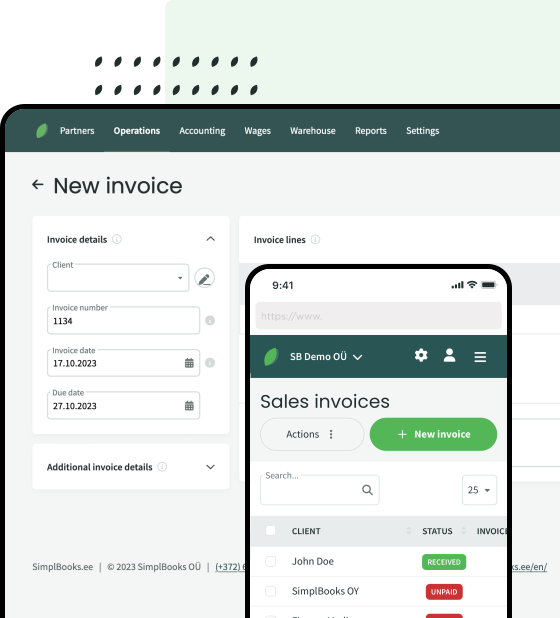
Accounting software such as SimplBooks can be used to create sales invoices, record purchase documents, apply VAT rates and keep accounting information in one place.
Automatic VAT calculations reduce manual work and the risk of entering an incorrect amount on an invoice.
Frequently asked questions
How much is 21% VAT on €100?
If €100 is the price excluding VAT, the VAT amount is €21 and the final price is €121.
How much VAT is included in a final price of €100?
If €100 is the price including 21% VAT, calculate the VAT as follows:
€100 × 21 ÷ 121 = €17.36
The price excluding VAT is €82.64.
How can you add 21% VAT quickly?
Multiply the net price by 1.21. For example, €500 × 1.21 = €605.
How can you remove 21% VAT?
Divide the gross price by 1.21. For example, €605 ÷ 1.21 = €500.
Does a business that is not registered for VAT add VAT to its invoices?
Generally, no. A person who is not registered for VAT does not show VAT separately on an invoice. However, VAT obligations may still arise after exceeding the revenue threshold, purchasing goods from other EU countries or buying services from abroad.
Summary
To calculate VAT from a net price, multiply the price by the applicable VAT rate. At the 21% rate, a net price of €100 produces €21 of VAT and a final price of €121.
To extract VAT from a gross price, do not simply reduce the amount by 21%. Divide the gross price by 1.21 and subtract the resulting net price from the total.
VAT payable is calculated by subtracting deductible input VAT from output VAT. Accurate calculations require the correct VAT rate, a proper assessment of the right to deduct input VAT and consistent recording of all sales and purchase documents.
Information updated in August 2026. This article is provided for general information only. For advice concerning a specific tax situation, contact the Lithuanian State Tax Inspectorate, an accountant or a tax adviser.



Leave a Reply